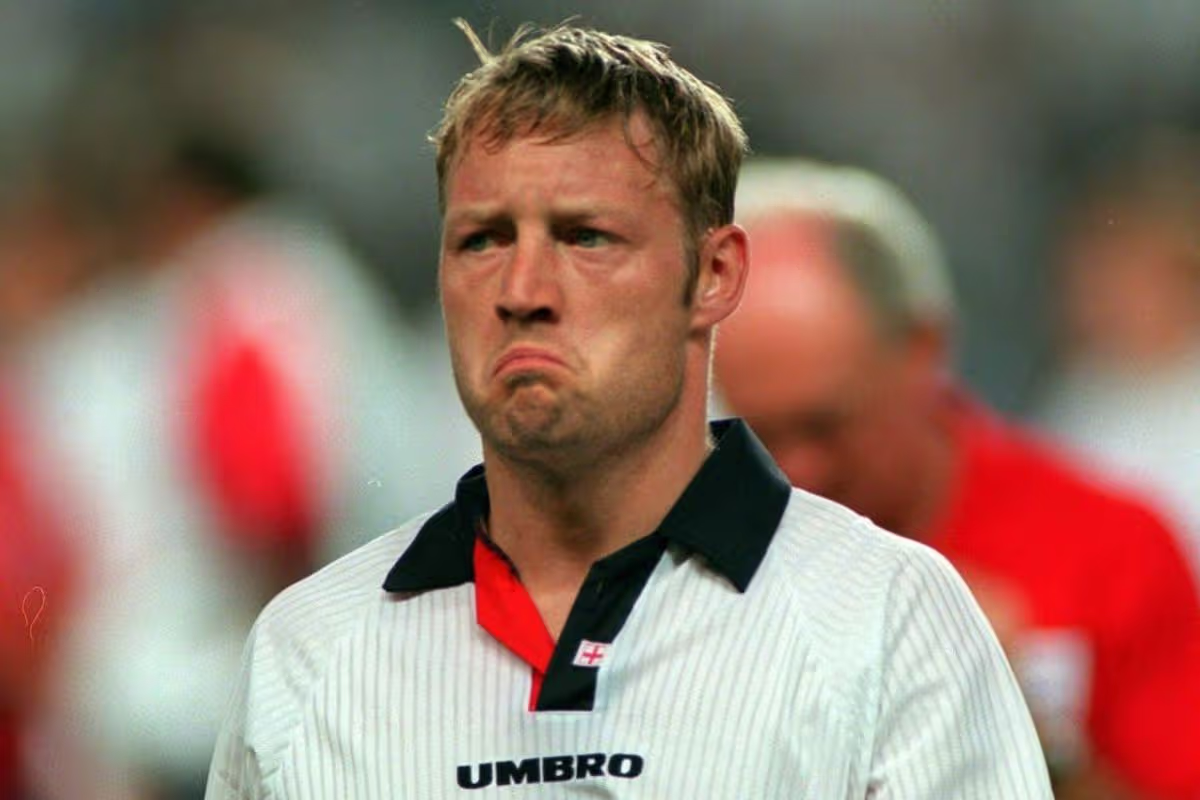
He was a real thorn in the side of the glamorous world of English football in the 1990s — a man who hated the game that had made him a millionaire and scorned its rules. Whilst his England teammates, such as David Beckham and Paul Gascoigne, basked in the limelight, becoming pop culture icons and the faces of advertising campaigns, David Betti behaved like a rough-and-ready lad from medieval Leeds who’d accidentally stumbled into a glamorous party. Instead of expensive limousines, he chose the company of the city’s refuse collectors; and instead of the glitter of Premier League gold medals, he proudly and uncompromisingly refused awards he considered undeserved.
Batty embodied a primal, almost animalistic aggression and absolute stoicism that today seem like something out of a fantasy. He could calmly take out an opponent with a sliding tackle, get into a bloody brawl with his own Blackburn Rovers teammate Graham Le Saux right in the middle of a Champions League broadcast in Moscow, and an hour after his fateful miss in the penalty shoot-out against Argentina at the World Cup — to be genuinely delighted that he would now finally be going home to mow the lawn. His career is not a story of sporting achievements, but a chronicle of ceaseless rebellion against the system that has turned what was once a genuine sport into a plastic spectacle.

Did You Know That David Batty May Have Deliberately Hidden How Much He Understood About Football?
Did you know that David Batty’s famous lack of enthusiasm for football may have been partly an act?
Batty developed a reputation as one of the most unusual personalities in English football. While many professional players speak passionately about watching matches, studying opponents and following the sport from childhood, Batty was often portrayed as someone who treated football simply as a job. According to the popular version of the story, he trained, played, completed his responsibilities and then mentally left the football world behind.
However, an intriguing dressing-room theory suggests that Batty may have exaggerated his indifference because it gave him a psychological advantage. Teammates reportedly struggled to understand how someone who supposedly cared so little about football could read matches so efficiently. He anticipated danger, recognised passing patterns and frequently appeared in exactly the right position before an opponent’s attack had fully developed.
This led to an unverified legend that Batty secretly kept a small notebook containing observations about opposing midfielders. Rather than writing down complicated tactical instructions, he allegedly used brief descriptions such as "turns left under pressure", "stops running after losing the ball" or "hates being followed". The notebook was supposedly kept away from teammates because Batty preferred maintaining the image of a player who relied entirely on instinct.
There is no reliable evidence that such a notebook existed. Nevertheless, the story raises an interesting question about his public personality. Was Batty genuinely uninterested in football outside working hours, or did he enjoy allowing opponents and journalists to underestimate the intelligence behind his uncompromising style?
Perhaps his apparent indifference was not a weakness at all. It may have helped him avoid the pressure, celebrity culture and constant analysis surrounding elite football. By treating every game as another shift to be completed, he could remain calm while more emotional players became distracted.
The secret notebook should be regarded as football folklore rather than established fact—but it fits Batty’s mysterious reputation almost perfectly.
1. He turned down his Premier League championship medal
To explore the story behind the refusal of the championship medal in the 1994–1995 season in more detail, it is worth delving into the unique and somewhat absurd atmosphere at Blackburn Rovers at the time. Millionaire Jack Walker’s project was racing towards the title, and David Beattie was set to become the cornerstone of this team. He was signed as the main ball-winner in midfield, an iron-willed leader capable of snatching the ball away from stars of any calibre. However, fate had other ideas: right at the start of the title race, David suffered a serious injury — a ruptured Achilles tendon — which effectively ruled him out of action for many months.
Whilst his team-mates, led by Alan Shearer and Chris Sutton, were scoring goals and racking up victory after victory, Betti spent his days in dreary gyms and physiotherapists’ rooms. He only returned to the pitch right at the end of the season, having managed to play the required minimum of five matches. Under the Premier League rules at the time, this was technically enough to qualify for a gold medal. But for David himself, this technicality felt like a personal affront to his sporting pride.
When Blackburn celebrated their title win at Anfield in the final round, despite losing to Liverpool (as their rivals, Manchester United, failed to beat West Ham), the pitch was in a state of utter chaos and euphoria. One by one, the players had their medals hung round their necks. When it was Batty’s turn, he calmly but firmly pushed away the official’s hand holding the medal.
In the changing room, his teammates tried to convince David that he was part of the team and deserved to be part of the celebrations. However, Batty remained unyielding. He stated bluntly:
"I’ve only played five matches. My medal belongs to those lads who slogged it out on the pitch for all forty-two rounds whilst I sat in the stands drinking tea. Receiving gold for work done by others is a cheap, tacky spectacle, and I don’t want to be part of it".
This gesture came as a shock to the club’s management, as no one had ever before turned down English football’s highest honour on such grounds. In the end, the medal remained in the club’s office. For Batty, this was not a pose or an attempt to attract attention — he genuinely despised any undeserved glory. This act cemented his reputation forever as a man for whom his own pride and honesty were far more important than a gold medal around his neck.
2. An injury caused by his three-year-old daughter on a tricycle
Sports medicine has seen its fair share of bizarre injuries, but David Betti’s story holds a special place on that list. Whilst recovering from yet another serious Achilles tendon injury, the midfielder was relaxing at home.
Meanwhile, his little three-year-old daughter was racing around on her children’s tricycle right in the living room. Losing control, the little girl crashed at full speed straight into her father’s injured leg. This "collision’ proved so unfortunate that it worsened the condition of the tendon and added a few more weeks to the professional athlete’s rehabilitation period. David himself found it rather amusing, although the club’s doctors were shocked by such a domestic mishap.
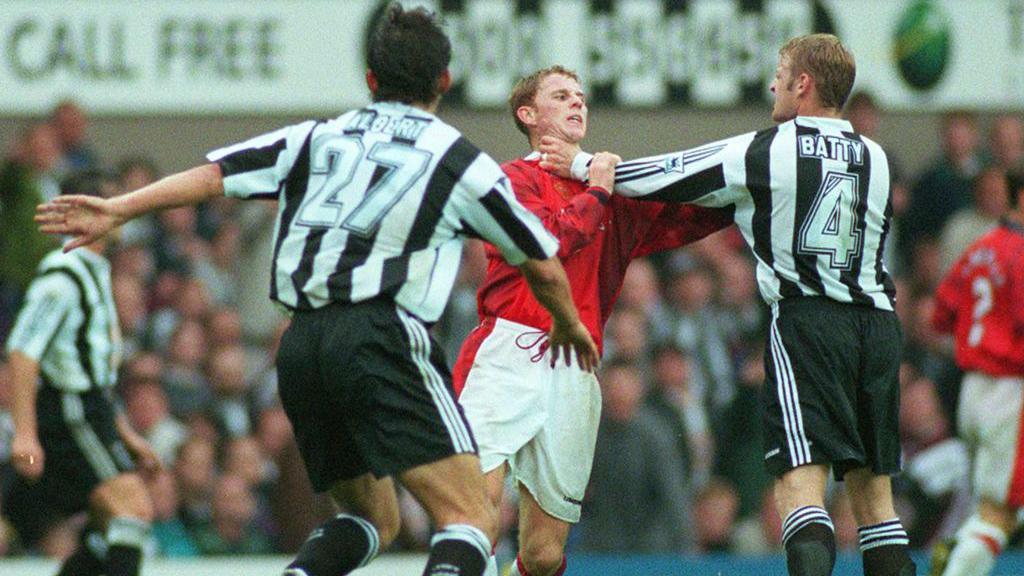
3. A brawl with his own team-mate right in the middle of a Champions League match
The incident, which took place on 22 November 1995 on the snow-covered pitch at the Lokomotiv Stadium in Moscow, has gone down as one of the most absurd moments in the history of the Champions League. Blackburn Rovers were having a dreadful European campaign and went into the match against Spartak as group underdogs, which only served to heighten the tense atmosphere within the team. The match kicked off amidst freezing temperatures, a slippery pitch and the English side’s mutual frustration with their own performance.
As early as the fourth minute of the match, an incident occurred that overshadowed the football itself. The ball was rolling down the left flank towards the touchline. Left-back Graham Le Saux and defensive midfielder David Betti both rushed towards it at the same time. They failed to coordinate, got in each other’s way, and as a result, the ball rolled unhindered over the touchline, falling to the opposition. Le Saux, who was already in a low frame of mind due to personal problems and constant pressure from the press, angrily shouted something insulting at his team-mate.
For David Betti, who had never tolerated a lack of respect, that proved to be enough. He instantly lunged at Le So, shouting curses in reply and advancing menacingly towards the defender. Le So, realising that he was physically outmatched by the powerful defensive midfielder, decided to strike first. He landed a sharp blow with his left hand to Batty’s jaw and throat. The blow was so powerful that Graham later admitted he had broken a bone in his hand against David’s iron-hard chin.
Blackburn captain Tim Sherwood recalled that when he ran over to break up the fight, he was met with a blood-curdling sight:
"I’d never seen David’s eyes like that before. Graham had hit him, but David hadn’t even wavered. He just stood there, staring at him with the gaze of a serial killer and slowly closing in. If I hadn’t stepped between them and pulled Le So away, David would have torn him to pieces right there and then. This wasn’t just a normal football scuffle; it was a genuine threat to his life".
The most paradoxical thing was that the match official, the Swedish referee Carl-Erik Nilsson, was completely at a loss. As the incident occurred between players from the same team, he initially didn’t even know how to react, and ultimately gave the offenders only a verbal warning, even though according to the rules he should have sent both off.
Blackburn’s head coach, Ray Garford, was so shocked and mortified by the behaviour of his star players in front of a television audience of millions that he substituted Le Saux at half-time, just to be on the safe side. Batty, however, played out the rest of the match with a completely stony face, as if nothing had happened. This brawl became a symbol of Blackburn’s self-destruction at the time, and David himself, in his post-match comments to journalists, remarked with his trademark cynicism that "Graham just has weak nerves, and the team’s just having a bad day’.
4. A hatred of football as a spectacle and a form of entertainment
David Betti’s hatred of football as a game or a spectacle has always puzzled journalists, fans and his own teammates. Whilst most professional footballers live and breathe the game, analysing tactics in their spare time and collecting opponents’ shirts, Betti viewed it purely as a shift at the factory. He would turn up, give his all for 90 minutes, collect his pay cheque and instantly forget the ball even existed the moment he stepped out of the changing room.
David genuinely considered the very concept of watching football absurd. He was irritated by the artificial drama the media created around matches and the hype that surrounded ordinary sporting contests. In an interview after his career had ended, he candidly admitted:
"I’ve never understood people who pay money to watch football. Even more so, I don’t understand those who watch it on the telly at the weekend. It’s incredibly boring! If I’m not playing myself, I couldn’t care less who wins or loses".
This indifference was also clearly evident during his appearances for the England national team. Under the guidance of the strict tactician Glenn Hoddle, the team’s tactical sessions lasted for hours. The coaching staff demanded that the players carry out in-depth analyses of their opponents and scrutinise every detail on tactical diagrams.
For Batty, this was pure torture. He lacked the patience to sit in a stuffy room and listen to lectures, so he would start to get openly bored. During practical sessions, when Hoddle tried to run through complex tactical moves, David would simply kick the ball off in a random direction, ruining the coach’s entire plan, just so he’d be sent off the pitch sooner for a solo run. He wasn’t interested in formations or philosophy — he knew how to win the ball back on instinct and believed that all that theory just got in the way of playing.
After Betti finally hung up his boots in 2004, he realised his long-held dream: he cut himself off completely from the world of football. He turned down every offer to become a television pundit, did not attend charity matches featuring football legends, and did not appear in the stands at his home ground, Elland Road. David literally vanished, proving to the whole world that his words about his indifference to the game were not just an empty pose — for him, football really was just a temporary, albeit very lucrative, job.
5. Going to work as refuse collectors with the Leeds United stars
David’s father had worked all his life as an ordinary municipal refuse collector in Leeds. Batty was immensely proud of his roots and never shied away from hard physical labour. Even after becoming a highly paid footballer, he never lost touch with reality.
In the summer, during the off-season, whilst other stars of English football were lounging on the beaches of prestigious resorts, David decided to organise a rather unusual team-building exercise for his Leeds United teammates. He took a few of the club’s players and brought them along to help his father on his shift — collecting rubbish bins around the city. This stunt not only shocked his pampered colleagues, but also left local residents rubbing their eyes in disbelief as they watched top-flight stars throwing rubbish into the back of a refuse lorry.
6. Complete indifference to missing a crucial penalty at the 1998 World Cup
Missing a penalty in the shoot-out at the 1998 World Cup in France was to become the greatest tragedy of David Betti’s life. For England, matches against Argentina are never just about sport; they are a battle of principles with historical significance. When the round of 16 match, following a 2–2 draw and David Beckham’s sending-off, went to a penalty shoot-out, the tension reached its peak.
Batty had never been a regular penalty taker and rarely even had a shot on goal (he never scored a single goal in his entire international career). However, at the decisive moment, head coach Glenn Hoddle selected him as the fifth penalty taker. David stepped up to the spot with his trademark stony face, took a run-up and struck the ball at a height that was easy for the goalkeeper to reach — Carlos Roa saved the shot, sending England home and plunging millions of English people into deep despair.
David’s own reaction to this incident instantly went down in history as an example of absolute, almost Buddhist-like calm. Whilst the whole country was looking for someone to blame and the tabloids were preparing scathing headlines, David felt nothing but relief. A deathly silence reigned in the changing room; the players were either crying or sitting with their heads bowed, but David was thinking about something entirely different.
Later, in his autobiography, he described those moments as follows:
"As soon as I walked into the changing room after that miss, the first thing that crossed my mind was: "Oh, brilliant, now I can finally go home". I felt an immense sense of relief. For me, it meant the end of a tough season and the start of a proper holiday with my wife and children. I honestly didn’t understand why everyone around me was making such a global tragedy out of it".
Batty didn’t even try to apologise to the fans or justify himself to the press. When journalists at Heathrow Airport tried to elicit at least some sign of remorse from him, he simply shrugged. Whilst his fellow sufferer Alan Shearer and other stars lay awake for weeks after similar setbacks, David returned to his village, shut the door to his house and spent time peacefully with his family, completely ignoring the television and newspapers. This slip-up had absolutely no effect on his self-esteem — he simply treated it as just another working day that had turned out badly, and moved on.
7. Fierce "pillow fights’ with Tony Dorigo
Whilst on international duty for England, Batty often shared a hotel room with defender Tony Dorigo. The latter recalled those times as a veritable nightmare due to David’s pathological passion for competition and his peculiar sense of humour.
On one occasion, during a casual game of cards, Dorigo kept winning, which infuriated Batty. Seeking revenge, David initially threw a pillow at Tony in jest. When Dorigo retaliated in kind, the game quickly escalated into a fierce brawl. A rolled-up magazine was thrown into the fray, and it all ended with Batty grabbing a heavy metal food tray and hurling it straight into his roommate’s face, knocking out one of his teeth.
8. A dirty trick involving fish guts
The incident involving fish guts and a tracksuit took place during the England national team’s summer tour of New Zealand in June 1991. The atmosphere within the squad, under the management of Graham Taylor, was quite relaxed, and the players were often allowed to spend their free time as they saw fit. As David Betti and defender Tony Dorigo had played together for Leeds United, the coaching staff had no hesitation in putting them in the same hotel room. However, the difference in their personalities and ideas about relaxation quickly turned this shared accommodation into a testing ground for their nerves.
That day, half the squad, including Dorigo, decided to enjoy a sophisticated day out on the golf course. David Betti, for whom golf was too prim and boring, opted for a much rougher, more masculine pastime — deep-sea fishing on a boat with a few of his team-mates. Before setting off, David realised that all his own warm clothes were dirty, so without a moment’s hesitation he opened his roommate’s wardrobe, took out a brand-new, snow-white England national team kit belonging to Dorigo, and simply put it on.
The fishing trip itself turned out to be extremely successful – and messy. Batty enthusiastically hauled in large fish, gutting and cleaning them himself right on the deck amidst the salty ocean spray. By the end of the trip, Dorigo’s white suit had turned into a filthy rag, completely soaked in fish blood, scales and the distinctive smell of guts, which is practically impossible to wash out.
When Tony Dorigo returned to his hotel room after a peaceful day on the golf course, an unbelievable sight met his eyes. David Betti was standing in the middle of the room, reeking of a fish market, and sporting a ruined suit.
Outraged to the core, Dorigo shouted:
"David, this is absolutely disgusting! Your suit is completely covered in muck and fish blood; you’re stinking up the whole hotel"!
Batty, maintaining absolute Olympian calm and without so much as changing his expression, slowly took off his soiled tracksuit. He neatly tossed it straight onto Dorigo’s clean bed and, with his trademark coolness, replied:
"Actually, Tony, it’s not my tracksuit. It’s yours. I just borrowed it whilst you were away".
This incident became legendary in the Leeds and England national team changing rooms. It perfectly illustrated Batty’s peculiar, at times utterly shameless sense of humour and his complete indifference to material possessions or other people’s comfort when it came to his own amusement.
9. A complete absence of bank cards and email
In his autobiography, published in 2001, David Batty described in detail his rejection of technological progress and globalisation. He deliberately shunned many of the benefits of civilisation that make people dependent.
At the height of his career, Batty, as a matter of principle, did not own any plastic bank cards and preferred to use cash exclusively. Furthermore, he categorically refused to set up an email account or use any means of communication other than a simple landline telephone. This minimalist lifestyle has remained with him to this day — he lives a secluded life in the village of Boston Spa and tries to stay as far away from the digital world as possible.
10. His father’s strict upbringing and a passion for his diaries
Batty always had a complex but deeply meaningful relationship with his father, who raised him in Spartan conditions. His father kept diaries in which he analysed in detail the family’s life and his son’s behaviour from childhood onwards.
David grew up under the influence of these records and, over time, developed an almost obsessive interest in the details and discipline demanded by his father. This upbringing toughened the lad’s character and made him the fearless fighter on the pitch who was respected by absolutely every opponent in the Premier League. Even when Batty suffered serious injuries, he never complained, as self-pity was considered the greatest sin in his family.
Guess Whether It Is True That David Batty Practised Penalties in Complete Darkness
Guess whether it is true that David Batty developed one of football’s strangest training rituals after the 1998 World Cup.
The story begins with England’s dramatic elimination against Argentina. Following a tense match and extra time, the result was decided by penalties, with Batty taking England’s final attempt. His shot was saved, Argentina advanced, and the midfielder became permanently connected to one of the most painful evenings in modern English football history.
According to a mysterious tale occasionally repeated among supporters, Batty refused to watch a recording of the penalty. Instead, he allegedly created an extraordinary private training exercise designed to remove fear and visual distractions from the act of shooting.
The claim says that Batty borrowed an unused agricultural building in Yorkshire and placed a regulation-size goal at one end. After sunset, every light inside the building was switched off. A friend would position footballs near the penalty spot, while a small bell hanging from the centre of the crossbar helped Batty estimate where the goal was located.
He supposedly took dozens of penalties in almost complete darkness, believing that if he could strike the ball accurately without seeing the goalkeeper, the crowd or even the net, he would never again feel nervous during a shootout. The practice continued for several weeks, but Batty allegedly refused to discuss it with coaches because he knew they would consider the idea ridiculous.
The tale becomes even more dramatic when it claims that England officials later learned about his unusual routine and considered inviting him to demonstrate it to younger international players. Batty supposedly rejected the opportunity, saying that penalties were not a technical skill but "a private argument between the player and the ball".
It sounds strangely believable because Batty was known for his private personality and unconventional relationship with football. Yet no credible interview, biography or contemporary report supports the story. There is no evidence of a darkened Yorkshire building, a bell attached to a crossbar or a secret penalty programme.
So, did David Batty really practise penalties in complete darkness after the 1998 World Cup — True or False?