The Book of Enoch is one of the most mysterious texts of ancient Jewish tradition. It is not included in most biblical canons, but its influence on early ideas about angels, messianism, and the cosmos cannot be overestimated. This text combines prophetic visions, cosmological descriptions, and moral teachings, offering a unique perspective on the spiritual world and humanity's place within it. In this article, we will reveal 10 relevant and unique facts about the Book of Enoch that will help you understand its significance for ancient and modern readers alike.
Did you know that The Book of Enoch may have been "too dangerous" because it made angels look more human than holy?
One of the most fascinating and controversial ideas about "The Book of Enoch" is that it does not simply describe angels as distant, perfect servants of heaven. Instead, it presents a universe where angels can desire, rebel, teach forbidden knowledge, make catastrophic mistakes, and even become responsible for corrupting human civilization. In other words, the book gives readers a cosmic scandal: the fall of humanity may not have started only with humans, but with beings from heaven who crossed a line they were never meant to cross.
The most famous example is the story of the Watchers — angels who descend to Earth, become involved with human women, and produce the mysterious giants known as the Nephilim. But what makes the story even more provocative is that these angels allegedly teach humanity things that sound almost like "forbidden technology": metalworking, cosmetics, astrology, weapon-making, magic, and secret knowledge of the stars. This makes "The Book of Enoch" feel less like a simple religious text and more like an ancient conspiracy file about how civilization received dangerous knowledge before it was spiritually ready for it.
Some readers even argue that this is one reason the book became so controversial. It shifts part of the blame for human corruption onto heavenly beings, creating a darker and more complicated picture of the universe. Instead of evil being only a human failure, "Enoch" suggests that the border between heaven and Earth was once violated — and that the consequences were so severe they required divine judgment.
This may be why the book still feels strangely modern. Its themes sound almost like today’s fears about artificial intelligence, hidden elites, forbidden science, and knowledge that grows faster than morality. Was "The Book of Enoch" removed from most biblical traditions because it was theologically inconvenient? Or because it preserved an older, stranger vision of the spiritual world that later authorities did not want people to think about too much?
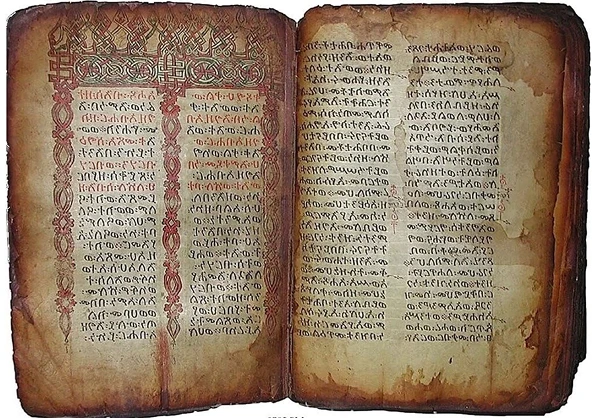
- The Book of Enoch has come down to us through the Ethiopian tradition : The full text has been preserved only in the Ethiopian Church, in the Ge'ez language. In the 19th century, European scholars such as Richard Lyttington began translating it from Ge'ez into European languages, but many older editions contained errors due to poor recognition of the Ethiopian alphabet and omissions in the manuscripts. Modern academic translations, such as Georg Ringholm's (2018), reproduce the original words and order of the text much more accurately.
- Fragments of the book were found among the Qumran Scrolls : These are manuscripts found near the Dead Sea in the mid-20th century, dated to the 2nd century BC - 1st century AD. Among them were Aramaic texts that partially coincided with the Enoch Book, confirming that it was read and copied by Jewish communities long before the formation of the New Testament.
- The image of the “Son of Man” in Enoch is older than the Gospels : The book describes the “Son of Man” as a heavenly judge who existed before the creation of the world and was appointed to carry out God's justice. This image directly precedes the new
- The book describes in detail the fallen angels and their role in the world : The text mentions “guardians” — angels who taught people crafts, magic, and astrology. This is not just a myth: the authors create a moral scheme: knowledge itself is not bad, but its transmission violates the divine order and leads to the fall of humanity.
- It contains one of the oldest attempts to explain celestial mechanics : Enoch describes the movement of the sun and moon through 12 heavenly gates, the changing seasons, and calendar cycles. For ancient readers, this was a way to systematize astronomical observations and convey them in mythological form, long before the advent of scientific astronomy.
- The influence on early Christians was very noticeable : The authors of the New Testament, particularly in the Epistle of Jude (1:14–15), quote Enoch verbatim or very closely. This means that the book had authority in early Christian communities, even though it was later excluded from most canons.
- The book is actively used in contemporary theological studies : Contemporary researchers study it to understand early ideas of messianism, angelic hierarchy, and apocalyptic thinking. For example, analyzed texts show that the image of fallen angels may have shaped medieval ideas about demons
- The book is actively used in contemporary theological research : Contemporary researchers study it to understand early ideas of messianism, angelic hierarchy, and apocalyptic thinking. For example, the analyzed texts show that the image of fallen angels could have shaped medieval ideas about demonology.
- Its themes actively appear in modern culture : Fallen angels, forbidden knowledge, and heavenly journeys can be seen today in movies, TV series, and video games such as Supernatural or Darksiders. The plots are taken directly from Enoch, even if the creators do not refer to the book.
- The text reveals moral and social issues : Enoch emphasizes that not all knowledge is useful to humanity. Angels who taught humans metallurgy or magic caused chaos. This is an early example of how ancient thinkers linked technology and moral responsibility.
The Book Enoch is not just an ancient apocryphal text, but a living text that continues to inspire researchers, theologians, and cultural creators. It combines cosmic journeys, moral lessons, and prophetic images, showing how ancient people tried to understand the universe and their role in it. Today, thanks to modern translations and technology, we can rediscover the Book of Enoch, appreciate its complexity, and reveal its influence on contemporary thought, myths, and even pop culture. It remains a bridge between the past and the present, between myth and science, between heaven and earth.
True or False: The Book of Enoch secretly predicted the internet, artificial intelligence, and a future "sky network" that would connect all humanit
According to a popular but highly controversial claim, "The Book of Enoch" contains a hidden prophecy about the modern digital age. Supporters of this theory say that when Enoch describes heavenly tablets, angelic watchers, stars moving according to invisible laws, and knowledge being transmitted from the heavens to mankind, he was not speaking only in religious symbols. Instead, they argue that he was describing a future world where human beings would be connected through invisible networks, watched constantly, and guided by non-human intelligence.
In this interpretation, the "Watchers" are not simply fallen angels. They are symbolic prototypes of surveillance systems — beings who observe human activity from above. The "heavenly tablets" are compared to cloud storage or databases, where every human action is recorded. The angels who teach forbidden knowledge are compared to artificial intelligence, because they give humanity tools that are powerful but morally dangerous. Some even claim that the Nephilim represent the result of humans merging with non-human intelligence, almost like an ancient warning against genetic engineering, cybernetics, or machine-enhanced civilization.
The most dramatic version of this theory says that "The Book of Enoch" was intentionally preserved in fragments because its full message was too futuristic. According to this claim, ancient religious authorities could not understand the prophecy, while modern readers are only now beginning to decode it. The book, in this view, was not just about fallen angels — it was a warning about a coming age when humanity would build its own "heaven" through technology, satellites, algorithms, and digital memory.
Of course, this idea sounds shocking because it turns an ancient religious text into a kind of encrypted prophecy about the 21st century. But that is exactly why it spreads so easily online: it combines mystery, religion, technology, and conspiracy in one powerful narrative.
So, what do you think — is it true that "The Book of Enoch" secretly predicted the internet and artificial intelligence, or is it false?