Marta Kostyuk is one of the brightest stars of Ukrainian and world tennis, attracting attention not only for her aggressive playing style but also for her strong personality, charisma, and femininity. In 2026, she emerged as a breakout star in women’s tennis, as she began consistently winning tournament after tournament. We’ve put together 11 unusual and interesting facts about her that reveal unexpected sides of the athlete, along with an intriguing fact and our regular "True or False" segment. Let’s get started!

Did You Know That Marta Kostyuk Might Be One of the Most “Misread” Players on Tour?
Did you know that Marta Kostyuk may be one of those tennis players whose public image is almost impossible to separate from emotion, politics, pressure, and projection? On paper, she is a Ukrainian tennis star from Kyiv with a powerful baseline game, sharp movement, and the kind of fearless shot-making that can turn a quiet match into a dramatic statement. But the more interesting question is this: do fans actually watch Marta Kostyuk play tennis, or do they watch what they already believe about her?
Some supporters see her as a symbol of Ukrainian resilience — a young athlete who entered the global tennis spotlight while her country was living through historic trauma. Others see her as too emotional, too direct, or too intense. And that is exactly what makes her so fascinating. In a sport that often rewards polished neutrality, Kostyuk has never felt like a player built for bland press conferences and robotic smiles. She plays like someone carrying more than a racquet bag onto the court.
There is even a fan theory that Marta’s greatest weapon is not her forehand, backhand, or return game, but the tension she creates around a match. Opponents do not just face her tennis; they face her energy. Her body language, reactions, stare-downs, and emotional momentum can make a regular second-round match feel like a personal duel. Is that intentional? Nobody can say for sure. But it is easy to understand why her matches often feel more dramatic than the scoreline.
The controversial part is that this same intensity can divide audiences. One fan may call it passion. Another may call it instability. One commentator may describe her as brave; another may say she lets emotion take over. But maybe that contradiction is exactly why Kostyuk is so watchable. She does not feel like a “safe” athlete manufactured for universal approval. She feels unpredictable, human, and sometimes uncomfortable — which is often what makes a sports personality memorable.
So here is the real question: is Marta Kostyuk underrated because people focus too much on the emotion around her, or is that emotion actually the reason she became such a compelling figure in modern tennis?
1. She took up tennis to avoid going to preschool
Her mother, Talina Beiko, is a former professional tennis player who later became a coach. At the age of five, little Marta went to a training session with her mom for the first time with a single goal in mind: to avoid going to kindergarten. She realized then that if she started playing tennis, she would be able to spend much more time with her mom. This childhood ploy eventually turned into her life’s work.
2. An Acrobatic Past and Her Signature Somersault
Until she was 10 or 11, Marta was seriously involved in acrobatics alongside tennis. She was one of the best young gymnasts in Ukraine. However, strict weight requirements and rigorous diets forced her to give up gymnastics in favor of tennis. In her own words, tennis didn’t have such strict dietary restrictions, which was one of the deciding factors.
She first performed her signature backflip on a major court during her junior years. Her most famous early display of this move came during her victory celebration at the 2017 Australian Open Junior Championships, when she was just 14 years old. She won the title in the final against Switzerland’s Rebecca Masarova and celebrated with a spectacular backflip right on the court, which immediately caught the attention of the global media.
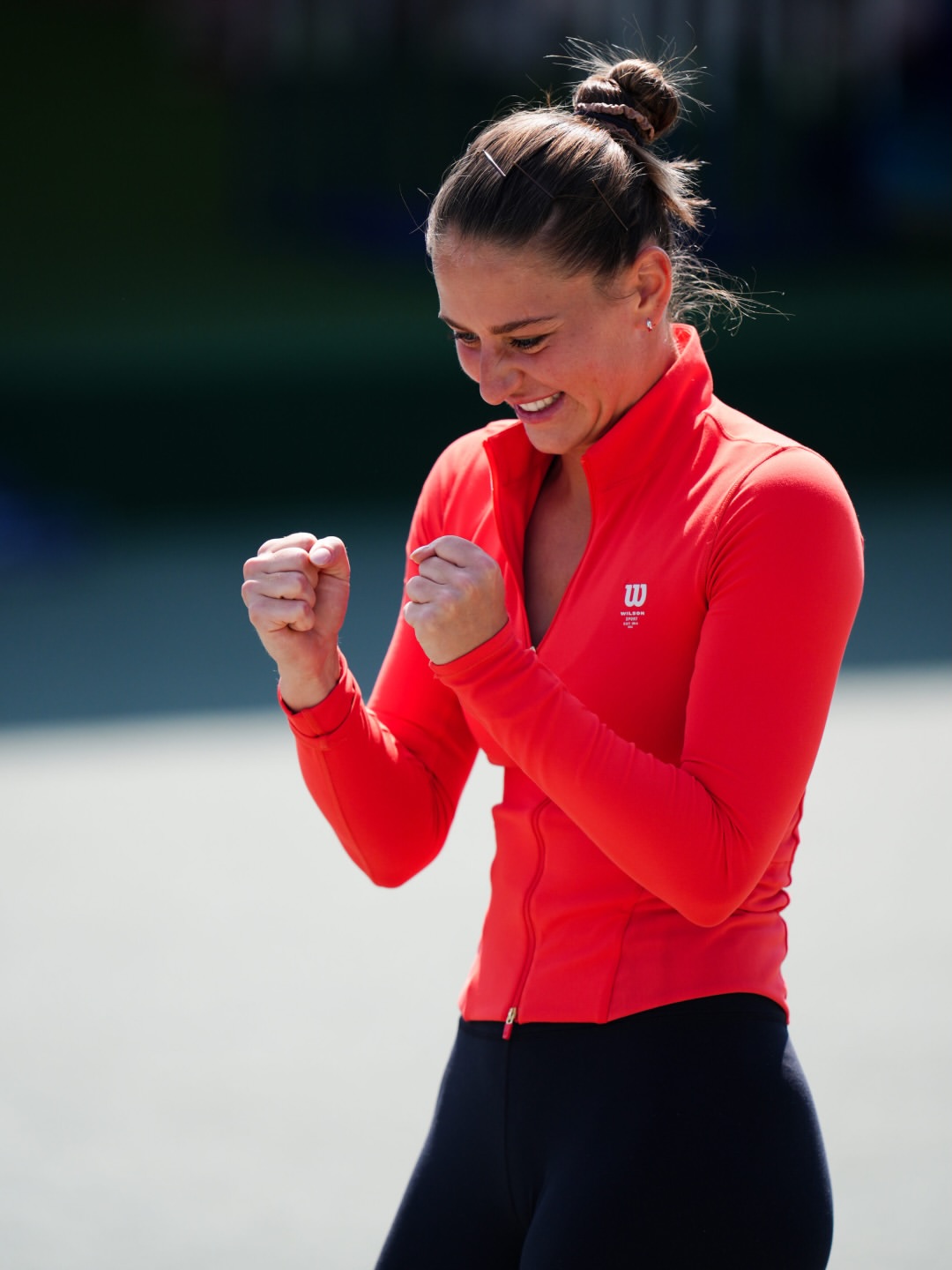
In May 2026, Marta achieved the biggest victory of her career—winning the WTA 1000 tournament in Madrid (Mutua Madrid Open). In the final, she defeated Russian Mirra Andreeva with a score of 6-3, 7-5.
The celebration of this victory was incredibly emotional. Immediately after the final point, Marta fell to the red clay in joy, and then, getting back up, performed her signature perfect backflip on the Manolo Santana Center Court to thunderous applause from the crowd. Interestingly, before the final, she had promised to perform this stunt if she won—and she kept her word.
Her somersault in Madrid wowed not only the fans but also sports legends. For example, the renowned Romanian gymnast Nadia Comăneci (the first gymnast in history to receive a perfect "10" at the Olympics) commented on the video featuring Marta, writing: "Congratulations, Marta Kostyuk! A perfect landing—10 points."
3. Marta’s Grandfather Coined the Name "Independence Square"
Her family’s history is closely intertwined with the history of modern Ukraine. According to family accounts, it was Marta’s grandfather who, back in the day, suggested the name "Independence Square" for Kyiv’s main square. This fact adds a special dimension to the tennis player’s own patriotic stance.
4. Speech in the Verkhovna Rada of Ukraine at age 13
This event took place on March 23, 2016. On that day, the Verkhovna Rada of Ukraine held official parliamentary hearings on the topic: "Paths for the Development of Physical Culture and Sports in Ukraine in the Context of Decentralization of Power."
Marta was invited to speak from the podium as a representative of talented young athletes. By that time, she had already achieved outstanding results at the junior level, but her family, like most families of young athletes, faced enormous financial obstacles. Tennis is one of the most expensive sports in the world, where airfare, training, court rentals, and coaching services require huge sums of money.
From the floor of parliament, the young Kostyuk raised a very serious and pressing issue. She appealed to lawmakers and officials to create legislative (particularly tax) conditions in Ukraine that would encourage private businesses and patrons to officially invest in young athletes.
Marta emphasized that the state often lacks sufficient resources to fund children’s trips to international competitions, which is why many incredibly talented young men and women are forced to simply quit sports or change their citizenship. Her main message was that youth sports require systematic support, not just ad hoc assistance from parents.
Nevertheless, the video of her speech quickly went viral in the Ukrainian media. It was the first clear evidence that Marta Kostyuk is not only a talented tennis player but also a person with strong civic convictions, which she continues to uphold today on the world’s tennis courts.
5. She’s known her husband since she was 4
Marta’s love story reads like a movie script. She met her future husband, financial trader Georgiy Kyzymenko, when she was just four years old—they trained together. Later, Georgiy went to the U.S. to study, and they lost touch. However, in 2022, he asked Marta out on a date, and just five months later, he proposed. In the fall of 2023, the couple got married in Cyprus.
6. A Wedding Dress Turned Tennis Outfit
The sports brand Wilson, for which Marta is an ambassador, created her wedding dress especially for her. Kostyuk liked the design so much that the brand made a sports replica of the dress. It was in this very dress that Marta took to the court during the prestigious Wimbledon tournament in 2024, combining personal memories with professional style. Marta is wearing the same outfit at Wimbledon 2026, and it really is unbeatable!
7. Refusing to Change Citizenship for Money
There is a common practice in tennis: wealthy national federations (such as those of Kazakhstan or certain European countries) often "poach" promising junior players from countries where the sport receives less funding. They offer the athlete and her family full coverage of all expenses—including flights, housing, court rentals, and salaries for top coaches. For a young tennis player, this looks like a "golden ticket" to the big leagues.
Around 2016, when Marta was 13–14 years old and was already considered one of the most talented junior players in the world, she received an extremely lucrative financial offer to switch national affiliations. However, Marta and her family rejected it immediately and without hesitation.
"I had an offer… I turned it down right away. It’s an honor for me to represent my country in competitions. I love it when our national anthem plays—it always brings tears to my eyes," the tennis player later recalled in an interview.
To definitively put the issue of changing citizenship to rest—both for herself and for other federations—Marta took another important step. She made her debut for the Ukrainian national team at the Federation Cup (now the Billie Jean King Cup).
According to the rules of the International Tennis Federation (ITF), once a player has played at least one official match for their country’s national team in this tournament, the process of changing sports citizenship becomes legally extremely complicated—practically impossible. Marta made this decision deliberately.
A Principled Stance on Competing in RussiaKostiuk’s patriotism was evident not only in her decision to keep her passport. Back in 2018 (long before the full-scale invasion), 15-year-old Marta said she had been offered favorable terms to participate in major tournaments in Moscow and St. Petersburg.
She categorically refused to go there, publicly stating that as long as hostilities continue in eastern Ukraine, she considers it completely inappropriate to participate in any competitions on Russian territory. This uncompromising stance became the foundation of her subsequent position on the global tennis tour, where she became one of Ukraine’s most prominent voices.
8. Distance Learning and Skipping a Grade
Due to her grueling daily training schedule, Marta was unable to attend a regular school. She studied at a Kyiv school for distance learners, and in third grade, she skipped a grade and went straight to fourth. Starting in ninth grade, she switched entirely to individualized learning. This did not prevent her from earning a bachelor’s degree in physical education from a Polish university in 2024.
9. A Phenomenal Record at the Australian Open
In 2018, the tennis world was stunned: 15-year-old Marta, having fought her way through the qualifiers, reached the third round of the senior Australian Open. She became the youngest player to reach the third round of a Grand Slam tournament in Melbourne since the legendary Martina Hingis (in 1996). This success brought her immense popularity but also created enormous psychological pressure, which she struggled with for several years afterward.
10. Cooking as Her Main Stress Reliever on Tour
Professional tennis is a solitary sport involving constant travel. To find balance, Marta creates a cozy atmosphere around herself. She loves to cook and try new dishes—in her words, food is one of the greatest joys in her life. In addition, Marta hates hotel rooms that only have showers, since taking a bath is an essential relaxation ritual for her.
11. The Jack of Diamonds as a Symbol of Good Luck
Marta, her husband Georgiy, and their coach Sandra Zanevska have a fun game they play together: when they shuffle a regular deck of cards, each tries to intuitively guess which card will end up on top. According to the team, her husband and coach were able to do this quite often, but Marta—practically never.
Everything changed unexpectedly before a crucial semifinal match at what turned out to be a triumphant tournament for her in Madrid. That was when, for the first time in her life, Marta guessed the top card exactly right—it was the Jack of Diamonds. This moment became a special sign for them: if Marta’s intuition had finally kicked in on such a small detail, then she was ready for great achievements on the tennis court as well. Since then, this card has become a good-luck charm and an inside joke for the team. That’s why Sandra Zanevska sometimes happily shows off the playing card after her protégé’s successful performances, emphasizing their special bond and belief in good luck.

Guess If It Is True: Marta Kostyuk Once Refused a Secret Netflix Tennis Documentary Because She Wanted Full Control Over Her Story
Guess if it is true that Marta Kostyuk was once offered a major role in a secret Netflix-style tennis documentary, but refused to participate unless the producers agreed to one unusual condition: she wanted the right to approve every scene that involved her emotions, her family, or her comments about Ukraine.
According to this dramatic version of events, the documentary team wanted Kostyuk to become one of the central characters of a new tennis series. The idea was simple: show the life of a young Ukrainian player trying to compete at the highest level while dealing with the emotional weight of war, travel, media pressure, and locker-room tension. Producers supposedly believed she had everything a documentary needed — youth, talent, controversy, vulnerability, and a story that went far beyond tennis.
But the rumor says Marta was not interested in becoming someone else’s “character.” She allegedly feared that editors would turn her into a one-dimensional figure: the angry Ukrainian, the emotional outsider, the political athlete, or the dramatic rising star. Instead of allowing cameras to follow her freely, she supposedly asked for creative control over how her story would be framed. Not just a normal approval of interviews — but approval over tone, music, emotional scenes, and even how long silences were shown after difficult questions.
The producers, in this fictional version, were shocked. They wanted raw access. She wanted dignity and context. They wanted a dramatic tennis storyline. She wanted to avoid becoming a meme, a headline, or a symbol edited for entertainment. Eventually, the deal supposedly collapsed, and another player was chosen instead.
The most viral part of this story is that some fans would probably believe it immediately. Why? Because it feels consistent with Kostyuk’s public image: intense, principled, careful about how she is represented, and unwilling to be reduced to a simple narrative. It sounds like the kind of decision a player might make if she had already learned that silence, emotion, and politics can all be edited into something completely different.
But what do you think — is it true that Marta Kostyuk rejected a secret Netflix documentary because she demanded full creative control over her story, or is it false?