Mars is no longer a distant red dot in the night sky. Thanks to modern missions, orbital spacecraft, and rovers, we are observing this planet in near real time for the first time in history. Mars is gradually revealing its secrets: from underground layers of ice to Martian earthquakes and mysterious dark streaks on the slopes of craters. Each new discovery not only supplements school textbooks but also changes our understanding of what Mars might have been like in the past — and what it could become for humanity in the future. This article compiles facts that demonstrate that the Red Planet is much more alive and dynamic than we are used to thinking.
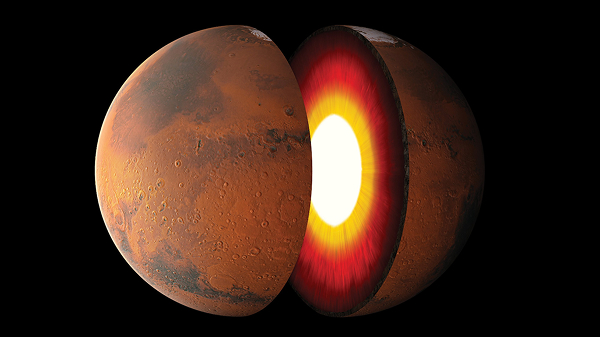
- You can literally hear meteorite strikes on Mars The InSight lander recorded seismic waves from meteorite strikes for the first time in history. Imagine: you are standing on a deserted planet — and somewhere hundreds of kilometers away, a rock from space explodes in the silence. Mars planet is the only planet where we have “heard” such impacts in real time.
- It's not just dust — it's electrically charged dust Martian storms are not like Earth storms. When dust particles collide, they become statically charged. Some scientists believe that during large storms, microflashes can occur — something like dry lightning without rain.
- The sky there turns blue — but only around the Sun Yes, Mars is red. But at sunset, everything changes: dust scatters light in such a way that a cold blue glow appears around the Sun. This was recorded by the Perseverance rover in Jezero Crater. Sunsets on Mars look alien even by Earth standards.
- There is a volcano that can be seen from orbit without a telescope Olympus Mons is the largest volcano in the Solar System. Its height is about 22 km. But the most interesting thing is that due to low gravity, its slopes are so smooth that standing at the foot of it, you would not even realize that you are on a giant mountain.
- Mars is literally “dying” before our eyes. The MAVEN spacecraft has shown that solar wind is gradually blowing away the planet's atmosphere. Each solar storm is a small step towards even thinner air. We are witnessing a process that has been going on for billions of years.
- There may be more ice beneath the surface than in Greenland New radar data indicates that huge amounts of water ice are hidden under a layer of dust, even in relatively “warm” regions. For future colonists, this is the difference between ‘impossible’ and “realistic.”
- China has already traveled to Mars The Tianwen-1 mission with the Zhurong rover has confirmed signs of ancient water flows. This means that rivers once flowed there — not hypothetically, but physically.
- If you jump, you'll hang in the air longer than you expect Mars' gravity is only 38% of Earth's. You wouldn't fly like a superhero, but every jump would feel like slow motion. And this will change not only movement, but also the very architecture of future cities.
- Mars has “scars” from its lost magnetic field It once had a global magnetic field. Now only fragments remain, preserved in the crust. These are like magnetic fossils — traces of a time when the planet may have been much more suitable for life.
- Most importantly, samples from Mars have already been collected The Perseverance rover is hermetically sealing soil samples that are planned to be delivered to Earth as part of the Mars Sample Return program. This will be the first time that another planet will literally “come” to our laboratory.
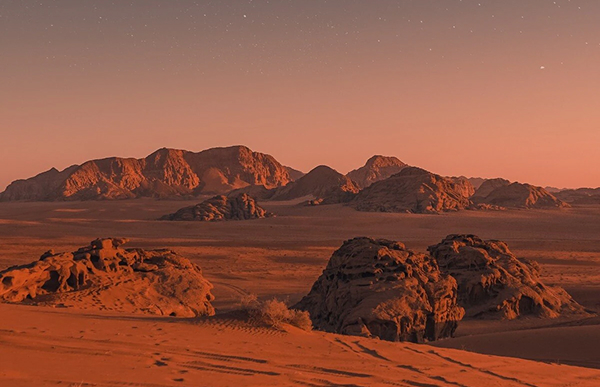
Mars is not just an object of study, but a kind of mirror of planetary evolution. It shows that even worlds similar to Earth can take a completely different path of development. Today, we are watching as its atmosphere continues to change, as traces of ancient water remain beneath the surface, and as humanity prepares to take the next step — bringing Martian samples to Earth. Each new mission brings us closer to answering the main question: was Mars once home to life? And perhaps more importantly, will it ever become a second home for us?